

When we examine gabardine and twill in our manufacturing processes, we're often asked which fabric specification suits a particular application. The distinction isn't merely aesthetic—it fundamentally affects production methods, end-use performance, and cost structures. While both employ diagonal weave construction, their thread counts, fiber selections, and finishing treatments create vastly different material properties. Understanding these technical differences determines whether your garment will meet its intended performance requirements or fall short in critical applications.
Key Takeaways
- Gabardine uses a tight 2/2 twill weave with over 100 threads per inch, while standard twill has a looser structure with 60-80 threads per inch.
- Gabardine offers superior water resistance and wrinkle resistance, making it ideal for formal suits and trench coats requiring professional appearance.
- Cotton twill provides softer hand feel and greater flexibility, commonly used in casual wear like denim jeans and chinos for enhanced comfort.
- Gabardine costs $10-$30 per yard due to complex weaving, while cotton twill ranges $7-$20 per yard with simpler construction.
- Gabardine requires gentle washing in cool water and air-drying, whereas cotton twill withstands warmer water and standard machine washing.
Introduction to Gabardine and Twill Fabrics
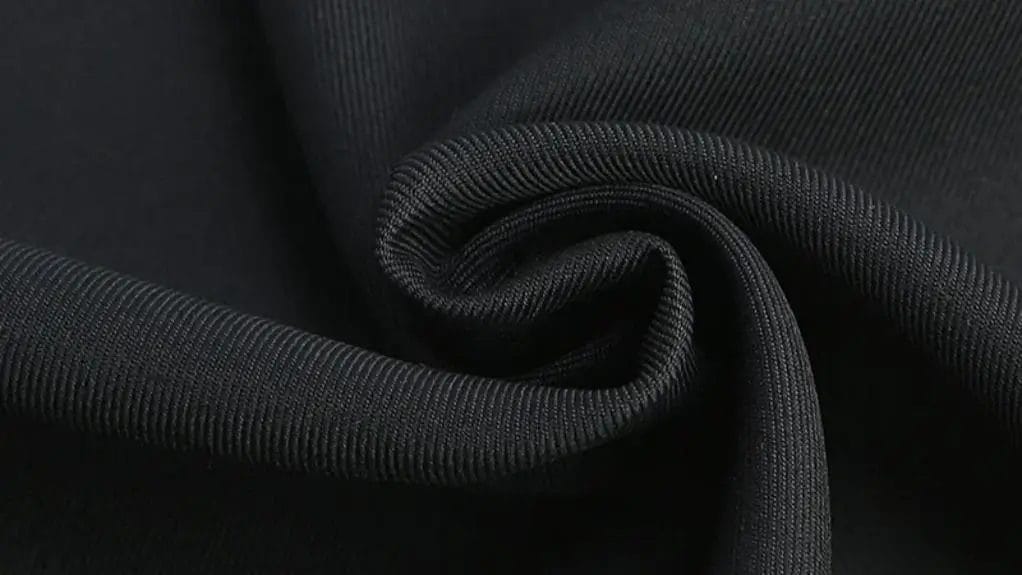
We'll examine gabardine and twill by analyzing their fundamental weaving structures and material compositions.
Gabardine utilizes a 2/2 twill weave with high warp density, producing a tightly woven fabric that Thomas Burberry developed in 1879 for weather-resistant applications.
Twill represents a broader weaving method employing a 2/1 diagonal pattern that accommodates various fiber types and creates a more flexible textile structure.
What is Gabardine Fabric? Definition and Composition
Gabardine stands as one of textile manufacturing's most precisely engineered fabrics, distinguished by its characteristic diagonal rib pattern and exceptional structural integrity.
Thomas Burberry developed this fabric in the late 19th century through a tightly woven construction that employs higher warp density relative to weft threads.
We'll find gabardine composed of wool, cotton, polyester, or blended fibers, each delivering specific performance attributes. The fabric's tight weave structure creates inherent wrinkle resistance and water repellency.
This manufacturing precision produces a thicker yet refined material that's become essential for tailored garments requiring durability and weather resistance while maintaining professional appearance standards.
Overview of Twill Fabric and Its Variations
Twill weave construction represents one of textile manufacturing's three fundamental weaving patterns, distinguished by its characteristic diagonal lines that form through a specific interlacing sequence.
We classify twill structures primarily as 2/1 or 3/1 configurations, where weft yarns pass over multiple warp yarns before going under one. This creates the fabric's signature diagonal ridges.
Manufacturers produce twill from various fibers—cotton, wool, silk, and synthetics—each yielding distinct performance characteristics.
Gabardine emerges as twill's specialized variant, featuring increased warp density that produces a tighter, more durable structure.
Standard twill maintains a softer hand feel, while gabardine delivers superior strength and water resistance through its compact construction.
Fabric Characteristics and Weave Differences
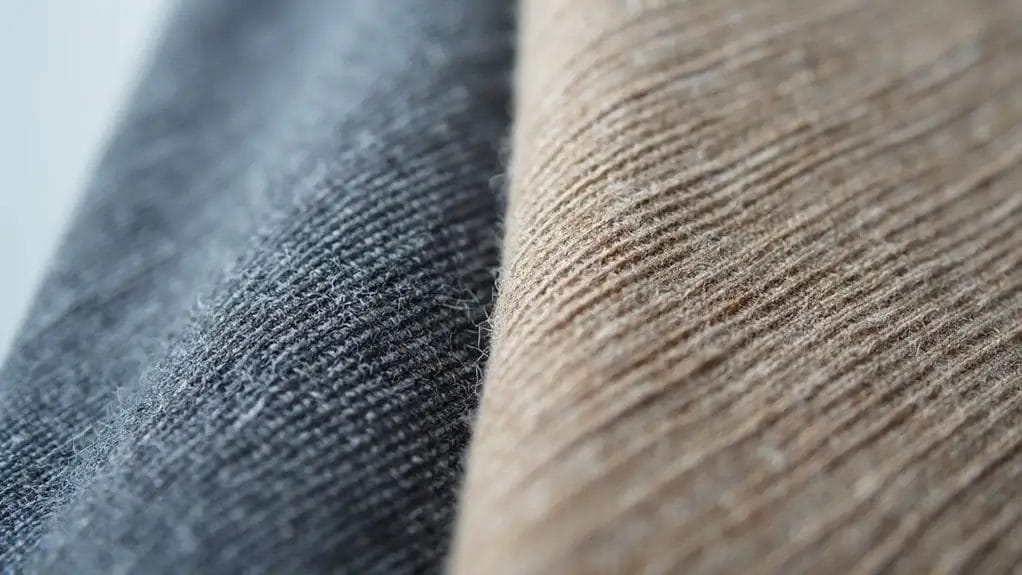
To understand gabardine's relationship to twill, we'll examine their fundamental weave structures and how these determine each fabric's performance characteristics.
Gabardine employs a steep-angle twill weave with considerably higher warp density than standard twill constructions, producing a compact, weather-resistant surface.
We'll compare the manufacturing specifications that create gabardine's tight diagonal rib against twill's more open, flexible structure, then evaluate how these differences manifest in texture, weight, and visual appearance.
Twill Weave Explained: How Gabardine Fits Within Twill Fabrics
When we examine the structural foundations of woven fabrics, the twill weave stands out for its distinctive diagonal rib pattern created by offsetting the weft thread over one or more warp threads in a progressive sequence.
Gabardine represents a specialized variant within this family, employing a 2/2 twill construction with notably higher warp density than standard twill fabrics. This tight weaving technique produces enhanced durability and water resistance while maintaining a softer back finish.
The resulting fabric demonstrates superior structural integrity, making gabardine ideal for tailored applications requiring both wrinkle resistance and dimensional stability in professional garments.
Tightly Woven Gabardine vs. Looser Cotton Twill
At the manufacturing level, gabardine's construction requires substantially higher warp thread counts—often exceeding 100 threads per inch—compared to cotton twill's more relaxed 60-80 thread configuration. This density differential creates distinct performance characteristics.
| Property | Gabardine | Cotton Twill |
|---|---|---|
| Weave Density | Tight, high warp count | Loose, balanced structure |
| Surface Texture | Firm, pronounced ribs | Soft, visible diagonal lines |
| Weather Resistance | Water/wind resistant | Breathable, casual wear |
The tighter weave in gabardine produces a heavier, more durable fabric with superior structural integrity, while cotton twill's looser construction offers enhanced flexibility and comfort for everyday applications.
Visual and Tactile Differences: Texture, Density, and Appearance
These structural distinctions manifest in immediate visual and tactile contrasts between the two fabrics.
Gabardine's high warp density creates a compact, firm texture with subtle diagonal ribs on the face and a characteristically smooth reverse side. Its tight construction produces a slight surface sheen and minimal drape.
Twill's looser weave yields softer hand-feel with pronounced diagonal wales visible on both sides. The reduced density allows greater flexibility and breathability.
Gabardine maintains dimensional stability and resists surface distortion, while twill offers pliability suited for draping applications.
These texture and density variations directly influence fabric performance across manufacturing specifications.
Fiber Content and Impact on Performance
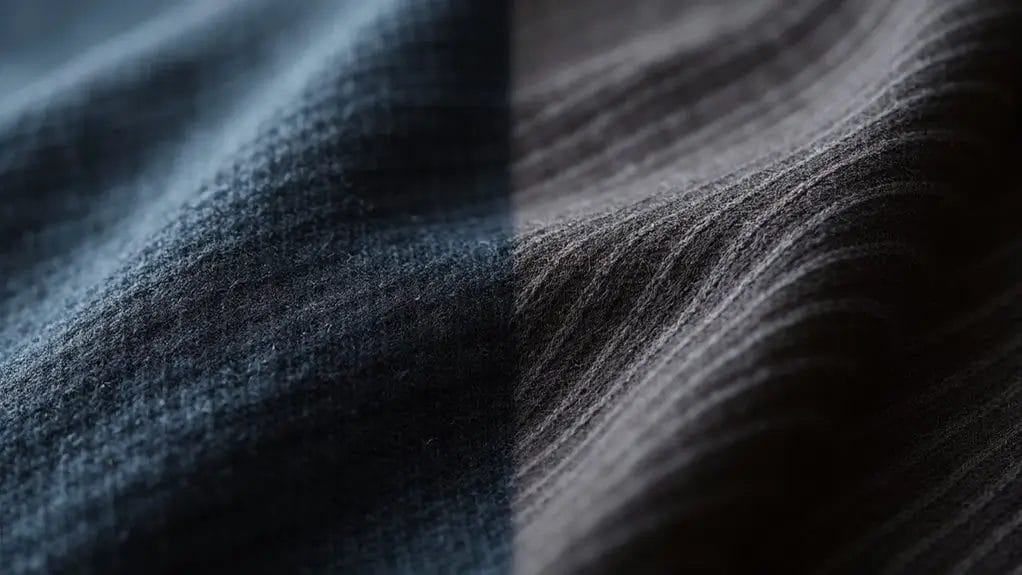
We'll now examine how fiber composition determines performance differences between gabardine and twill fabrics.
Gabardine utilizes wool, cotton, and polyester blends in varying ratios to achieve specific structural properties—each fiber contributing distinct advantages in durability, water resistance, and wrinkle recovery.
Cotton twill, by contrast, relies primarily on fiber length and yarn twist to balance breathability against the tighter weave density characteristic of cotton gabardine construction.
Wool, Cotton, Polyester Blends in Gabardine: Pros and Cons
Each fiber type transforms gabardine's performance characteristics in distinct ways that directly affect manufacturing decisions and end-use applications.
Wool gabardine delivers superior breathability and natural elasticity for tailored suits, though it demands higher material costs and delicate handling.
Cotton variants offer excellent softness for summer garments but compromise durability and water resistance.
Polyester provides wrinkle-resistance and cost efficiency while sacrificing breathability in high-temperature environments.
Strategic fiber blends optimize performance by combining synthetic moisture-wicking properties with cotton's comfort characteristics.
We've found that blend ratios directly influence care requirements, with synthetic-dominant compositions simplifying maintenance protocols compared to wool-rich formulations requiring specialized treatment.
Cotton Twill vs Gabardine: Breathability, Durability, and Feel
Cotton twill's looser weave structure creates distinct performance trade-offs when compared to gabardine's tightly compacted construction. We'll examine how weave density directly impacts breathability and durability across both fabrics.
| Property | Cotton Twill | Gabardine |
|---|---|---|
| Breathability | High airflow from open weave | Restricted by tight construction |
| Durability | Moderate shape retention | Superior wrinkle resistance |
| Surface Feel | Rougher texture | Smooth against skin |
Cotton twill's looser construction enables better air circulation for warm-weather applications, while gabardine's compressed fibers deliver enhanced wind resistance and structural integrity. The tighter weave produces gabardine's characteristic smooth finish, whereas twill maintains a slightly textured surface from its 2/1 construction.
Practical Uses of Gabardine and Twill Fabrics
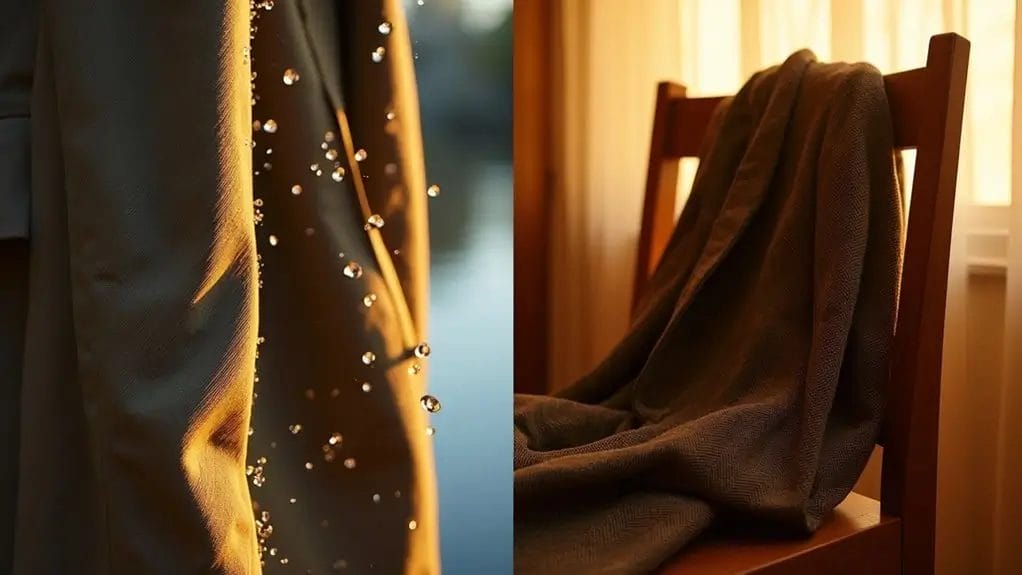
We'll now examine how weave structure and fiber density determine ideal applications for gabardine and twill fabrics.
Gabardine's tight 2/2 weave construction makes it the preferred choice for structured garments like suits, trench coats, and formal uniforms where wrinkle resistance and weather protection are critical.
In contrast, twill's looser 2/1 weave delivers the breathability and drape required for casual wear and industrial workwear applications.
Best Applications for Gabardine: Suits, Trench Coats, Uniforms
Gabardine's tightly woven structure makes it the preferred choice for garments that demand both durability and a refined appearance.
We'll find it's particularly suited for manufacturing suits, where its firm hand maintains clean lines and sharp tailoring. The fabric's 2/2 twill construction delivers exceptional shape retention in fitted applications.
For trench coats, gabardine's tight weave provides inherent water and wind resistance, making it functionally superior to looser weaves.
In uniforms, we appreciate its wrinkle resistance and professional finish that withstands repeated wear cycles.
The material's density guarantees consistent performance across high-stress applications requiring structured garments.
Common Uses of Cotton Twill in Casual and Workwear
Three primary characteristics make cotton twill the workhorse fabric of casual and industrial applications: its diagonal rib construction resists abrasion, its medium-weight density balances durability with breathability, and its production costs remain consistently lower than gabardine.
We find cotton twill deployed extensively in denim jeans and chinos, where its 2/1 weave structure delivers everyday comfort without sacrificing tensile strength.
In workwear manufacturing, this fabric dominates uniform production and apron construction—the weave withstands repeated laundering cycles while maintaining professional aesthetics.
Its versatile manufacturing profile supports both casual garment production and industrial workwear applications, making it indispensable across multiple textile sectors.
Project Suggestions Based on Fabric Strengths and Limitations
When selecting fabrics for specific sewing projects, we must match material properties to functional requirements.
Gabardine's tight weave and structural integrity make it ideal for tailored blazers, dress trousers, and outerwear requiring weather resistance. Its dimensional stability guarantees garments maintain crisp lines through repeated wear.
Conversely, twill's flexibility suits applications demanding drape—shirting, casual skirts, and lightweight workwear. For projects requiring extended comfort, gabardine's smooth surface excels in structured pieces worn long-term. Twill works best in relaxed-fit designs where breathability matters.
Understanding each fabric's mechanical properties—density, flexibility, durability—enables precise project planning and ideal garment performance outcomes.
Sewing Tips for Gabardine and Twill Fabrics
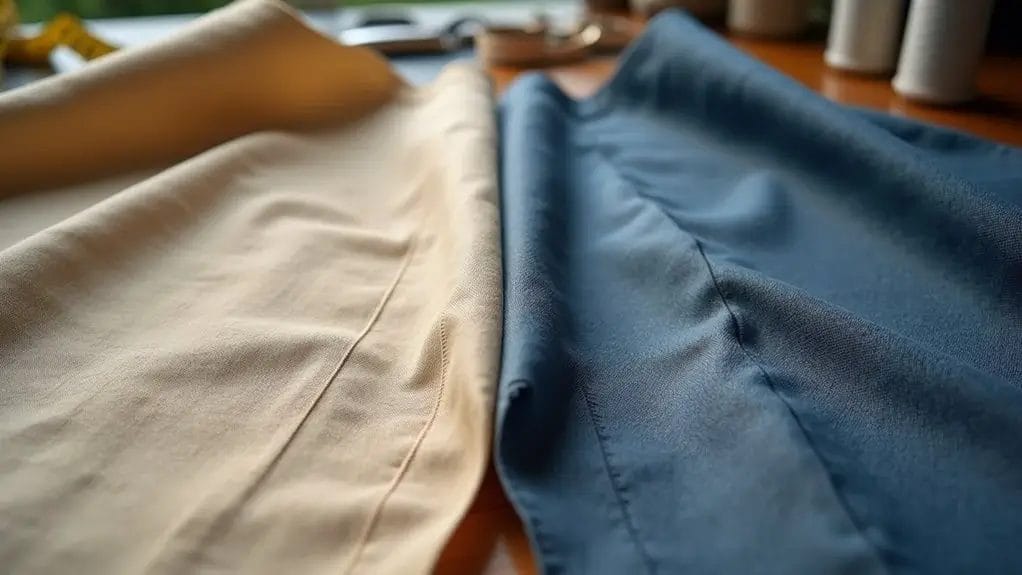
We'll examine the technical requirements for working with gabardine and cotton twill, starting with fabric preparation and cutting techniques that account for their distinct weave structures.
Our focus includes selecting appropriate needles, threads, and stitch lengths that accommodate each fabric's density and weight characteristics.
We'll also address pressing methods and solutions for common construction challenges like seam puckering and fabric distortion.
Preparing and Cutting Gabardine and Cotton Twill
Before cutting into gabardine or cotton twill, we must pre-wash the fabric to eliminate shrinkage variables that'll compromise our finished garment dimensions. This pre-washing step guarantees accurate measurements throughout the sewing process and post-construction wear.
When cutting gabardine's tightly woven structure, we recommend employing a rotary cutter to achieve clean edges and minimize fraying. For best sewing results on heavier fabrics, we'll need a sharp 90/14 or 100/16 denim needle.
Rather than pins, clips provide superior layer control when managing these fabrics' thickness, preventing distortion during assembly while maintaining precise alignment for professional-grade construction.
Needle, Thread, and Stitch Length Recommendations
Since gabardine's dense weave structure demands specific tooling for ideal construction, we'll match our needle selection to the fabric's technical requirements.
- Gabardine needle specification: Deploy 90/14 or 100/16 denim needles to penetrate the fabric's high warp density without deflection or breakage.
- Twill needle approach: Universal needles work adequately, though sizing up accommodates weight variations across twill types.
- Thread requirements: Jeans or upholstery thread provides necessary tensile strength for stress-bearing seams in both fabrics.
- Stitch length parameters: Set 3-3.5mm lengths for gabardine construction to prevent puckering while maintaining structural integrity throughout garment assembly.
Pressing Techniques Including Press Cloth Use for Gabardine
Pressing gabardine demands three critical controls: temperature regulation, press cloth deployment, and steam management.
We'll set our iron to medium temperature, particularly essential when synthetic blends are present.
The press cloth serves as our primary defense against shine marks and finish damage—it distributes steam evenly while shielding fibers from direct heat contact.
We shouldn't apply heavy pressure; instead, we'll let steam action perform the work. This approach sets seams effectively and eliminates wrinkles without compromising gabardine's structural integrity.
The 2/2 twill weave responds best to controlled heat application through protective barriers.
Troubleshooting Common Issues — Seam Puckering, Fabric Distortion
Even with proper pressing protocols in place, seam puckering and fabric distortion remain persistent challenges when sewing gabardine and twill.
We'll address these manufacturing defects through targeted interventions:
- Extend stitch length to 3-3.5mm for gabardine to accommodate its dense weave structure and minimize seam puckering along construction lines.
- Apply walking foot attachments to guarantee even fabric feeding through the machine, preventing differential movement between layers.
- Pre-wash all yardage before pattern cutting to eliminate post-construction shrinkage and fabric distortion.
- Substitute clips for pins during assembly to avoid puncture marks and pressure-induced puckering in tightly woven fibers.
How to Care for Gabardine and Twill Fabrics
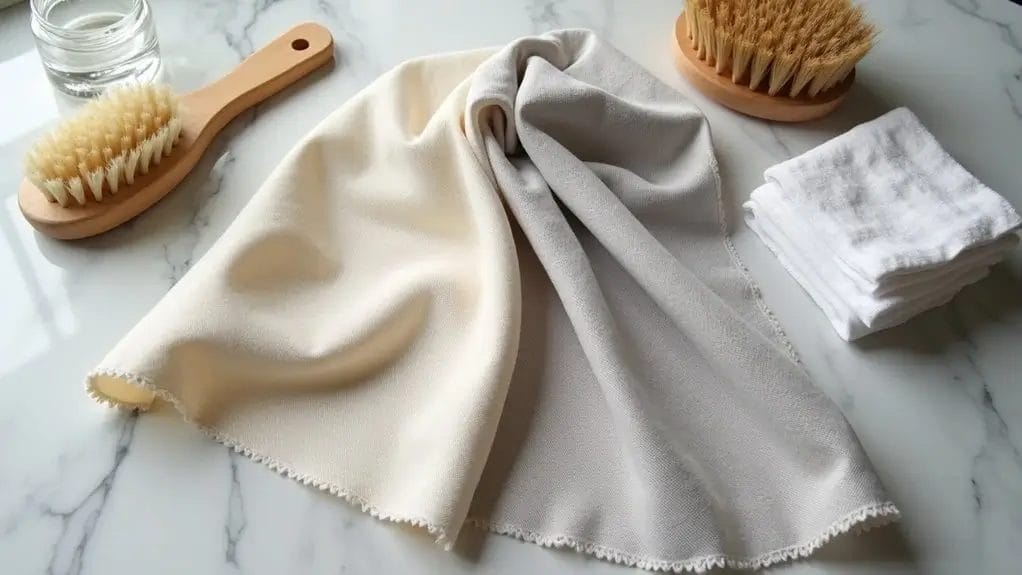
We'll examine proper maintenance protocols for both gabardine and twill fabrics to preserve their structural integrity and extend garment lifespan.
Each fabric type requires specific washing methods based on fiber composition, with distinct considerations for machine washing versus dry cleaning applications.
We'll cover essential procedures for storage, pressing techniques, and stain removal that account for each fabric's weave density and surface characteristics.
Washing Instructions by Fiber Type
Since gabardine and twill fabrics differ in their weave density and fiber composition, they require distinct washing approaches to preserve their structural integrity.
Fiber-Specific Washing Protocols:
- Wool-Cotton Gabardine: We wash in cool water using mild soap on gentle cycle to prevent shrinkage and maintain dimensional stability.
- Cotton Twill: We employ similar gentle care but can utilize slightly warmer water for enhanced cleaning efficiency.
- Drying Process: We air-dry both materials; if machine-drying, we select low-heat settings to prevent fiber distortion.
- Post-Wash Treatment: We iron damp gabardine to avoid surface shine; twill accepts dry pressing without structural compromise.
Dry Cleaning vs Machine Washing: When to Choose Which
While both gabardine and twill can withstand various cleaning methods, we determine the appropriate approach based on fiber composition and weave density rather than fabric type alone.
| Fabric Type | Recommended Method |
|---|---|
| Wool gabardine | Dry cleaning |
| Cotton gabardine | Machine washing (gentle) |
| Standard twill | Machine washing (cold) |
| Heavy twill/synthetic blends | Dry cleaning |
Gabardine's 2/2 weave structure demands dry cleaning to prevent shrinkage and maintain its tightly woven integrity. Twill's looser 2/1 construction tolerates machine washing on gentle cycles. We always verify care labels, as fiber content overrides general fabric classifications in determining proper maintenance protocols.
Tips for Storage, Ironing, and Stain Removal
Proper maintenance extends beyond washing cycles—storage conditions and spot treatment directly impact fabric longevity.
We'll outline critical procedures for preserving these twill-weave textiles' structural integrity.
Essential Maintenance Protocols:
- Storage: Utilize padded hangers or breathable garment bags to prevent creasing and maintain dimensional stability.
- Ironing: Apply medium heat with steam for gabardine; reduce temperature for twill to prevent fiber degradation.
- Stain Removal: Blot immediately with damp cloth and mild detergent; avoid harsh chemicals that compromise weave structure.
- Wrinkle Prevention: Roll garments rather than folding to minimize stress points during storage or transport.
Cost, Availability, and Sustainability Considerations
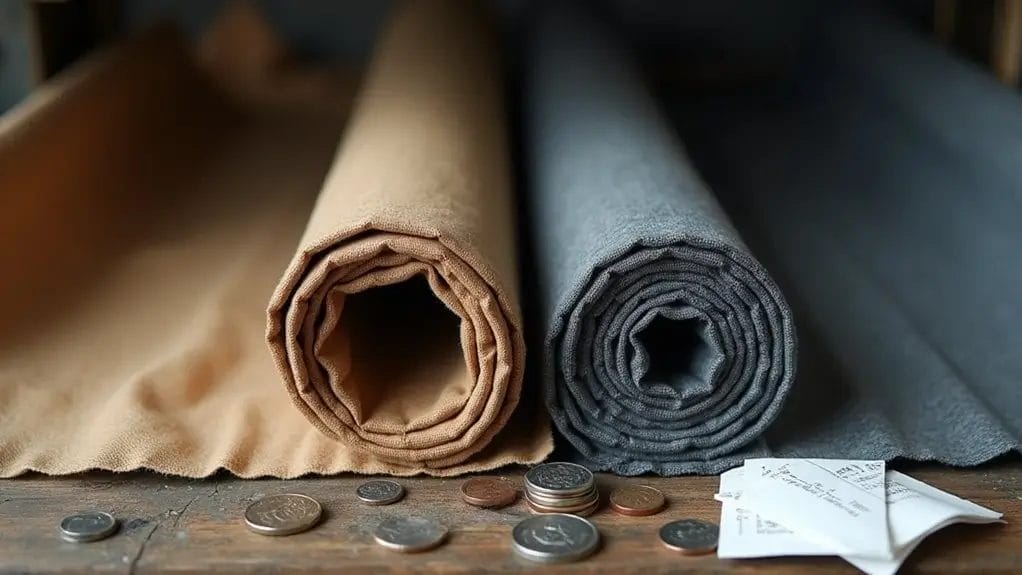
We'll examine how manufacturing specifications and fiber selection directly impact the cost structure of gabardine versus cotton twill, with gabardine ranging from $5 to $50+ per yard compared to twill's $10 to $30 range.
The production methods and material sourcing for these weave structures determine both their market availability and environmental footprint, particularly as synthetic blends compete with natural fiber options.
We'll outline practical criteria for evaluating fabric quality and supply chain transparency when selecting between these materials for specific applications.
Price Comparison of Gabardine vs Cotton Twill
When comparing manufacturing costs, gabardine commands a premium over cotton twill due to its higher warp density and more complex 2/2 weave structure.
We'll examine the price comparison between these fabrics:
- Cotton gabardine: $10-$30 per yard, reflecting intricate manufacturing processes and material density
- Cotton twill: $7-$20 per yard, benefiting from simpler 2/1 weave construction
- Production complexity: Gabardine requires specialized equipment and precise tension control
- Market positioning: Gabardine targets formal wear segments, while twill serves broader applications
The cost differential stems from gabardine's demanding production requirements and fiber density, making twill more economical for casual garment manufacturing.
Environmental Impact of Fabric Production and Blends
While both gabardine and twill share similar weave structures, their environmental footprints diverge notably based on fiber composition and manufacturing intensity.
Gabardine's higher warp density demands increased water and energy consumption during production.
Synthetic blends in both fabrics reduce reliance on conventional cotton's pesticide requirements but introduce petroleum-based environmental costs and recycling complications.
We've observed that 100% natural fiber variants offer superior end-of-life biodegradability, though organic cotton options increase production costs markedly.
Sustainable manufacturing practices, including low-impact dyeing and organic sourcing, mitigate environmental damage but affect regional availability and pricing structures across both fabric types.
How to Source Quality Fabrics with Ethical Considerations
Sourcing quality gabardine and twill requires systematic evaluation of supplier credentials, production methodologies, and material certifications.
We must prioritize transparency in supply chains while balancing cost constraints and sustainability objectives.
Essential Sourcing Parameters:
- Cost Analysis: Wool gabardine ranges $20-$50+ per yard; polyester variants cost $5-$15 per yard.
- Supplier Verification: Request fabric swatches to assess quality before bulk purchasing.
- Certification Standards: Verify Organic or Fair Trade certifications for responsible sourcing.
- Sustainability Metrics: Select recycled content or organic fiber options to minimize environmental impact.
Research multiple suppliers—online and local—to guarantee availability while maintaining ethical production standards and material integrity.
Frequently Asked Questions
What's the Difference Between Gabardine and Twill?
We'll find that gabardine uses a tighter 2/2 twill weave with higher warp density, creating a stiffer, more durable fabric, while standard twill employs a looser 2/1 construction, yielding softer, more flexible material.
What Are the Disadvantages of Gabardine?
We've found gabardine's main drawbacks include susceptibility to pilling in lower-quality blends, reduced breathability from its tight weave construction, higher manufacturing costs, limited draping flexibility, and a formal sheen that restricts versatile applications.
What Kind of Fabric Is Gabardine?
Gabardine's a tightly woven twill fabric with a 2/2 weave structure and high warp density. We'll find it features diagonal ribs, exceptional durability, and water-resistant properties, making it ideal for structured garments requiring shape retention.
Is Gabardine a Twill Fabric Appropriate for Suiting?
Yes, we'd consider gabardine an excellent twill fabric for suiting. Its tight 2/2 weave construction delivers superior wrinkle resistance and dimensional stability, while the high warp density guarantees durability and maintains crisp lines throughout garment wear.
Conclusion
We've examined the structural distinctions between gabardine's tight 2/2 twill weave and standard twill's 2/1 construction, analyzing how these manufacturing differences impact fabric performance, fiber selection, and end-use applications. We've covered essential sewing techniques specific to each weave structure and outlined maintenance protocols that preserve fabric integrity. By understanding these technical specifications—from warp density to weave angles—we can make informed decisions about fabric selection, balancing performance requirements with production costs and sustainability metrics in our manufacturing processes.
0 comments